Early products often become too large because every possible feature feels important. A smaller start gives the product a better chance to reach users, produce feedback, protect budget, and avoid months of work on assumptions that may be wrong.
Small scope increases learning speed
The first release should create feedback. It does not need to contain every planned feature. It needs to reach the right people and show what they actually do.
A large first version can feel safer, but it usually delays the moment when the team receives real signals from users.
Learning speed matters because early assumptions are fragile. The team may be wrong about the audience, price, feature priority, onboarding, copy, or distribution channel. A smaller release finds these problems earlier.
- Shorter build time means earlier feedback.
- Fewer features make user behavior easier to understand.
- Smaller releases are easier to change after feedback.
- A narrow promise is easier to explain in marketing and onboarding.
Fewer features means less noise
When the first release is too broad, it becomes difficult to understand what worked and what failed.
A smaller product makes feedback easier to read. The team can see whether the main promise is strong enough before adding more layers.
Noise is not only a design problem. It appears in analytics, support, code, project management, and team decisions. A broad first release creates many possible explanations for weak results.
- One main user path.
- One clear success event.
- One primary audience.
- One short release plan.
- One feedback process after launch.
A focused first version is easier to finish, easier to test, and easier to improve.
Small scope protects the budget
Every feature creates design work, code, testing, edge cases, and support tasks. Even simple screens can become expensive when they touch payments, accounts, permissions, or data.
Cutting scope early is cheaper than removing half-built features later.
A large first version also creates hidden cost: more meetings, more dependencies, more bugs, more QA time, more deployment risk, and more explanation needed for users.
- Fewer screens to design and test.
- Fewer edge cases before launch.
- Fewer admin tools needed on day one.
- Fewer support questions from early users.
- More budget left for improvements after real feedback.
Use a scope cost table before saying yes
A feature can look small in a conversation and become expensive in implementation. A scope cost table helps the team see the work behind a request before it is accepted.
The table does not need complicated scoring. It should make hidden work visible.
- Design cost — new screen, new component, new empty state, new mobile layout.
- Backend cost — model change, API endpoint, permission rule, validation, migration.
- QA cost — success case, failure case, edge cases, device checks, browser checks.
- Support cost — user explanation, admin handling, recovery path, documentation.
- Launch risk — payment risk, data loss risk, security risk, or main path delay.
| Request | Design | Backend | QA | Launch risk | Verdict |
|---|---|---|---|---|---|
| Saved filter presets | Medium | Low | Medium | Low | Should-have after core list works |
| New billing plan type | High | High | High | High | Defer until the first plan is proven |
Protect the main product promise
A small scope should not mean a weak product. It should protect the main promise and remove work that distracts from it.
The first release should make one promise and keep it well. If the product promises a faster way to create a report, the report flow matters more than account settings, theme options, and advanced dashboards.
- Write the product promise in one sentence.
- List the actions required to fulfill that promise.
- Cut or postpone features that do not support those actions.
- Make the main result clear and satisfying.
- Use feedback to decide what the second promise should be.
A simple path for shipping the first useful version.
- Choose one user
- Define one path
- Build must-haves
- Launch small
- Improve from feedback
Cut features with respect, not chaos
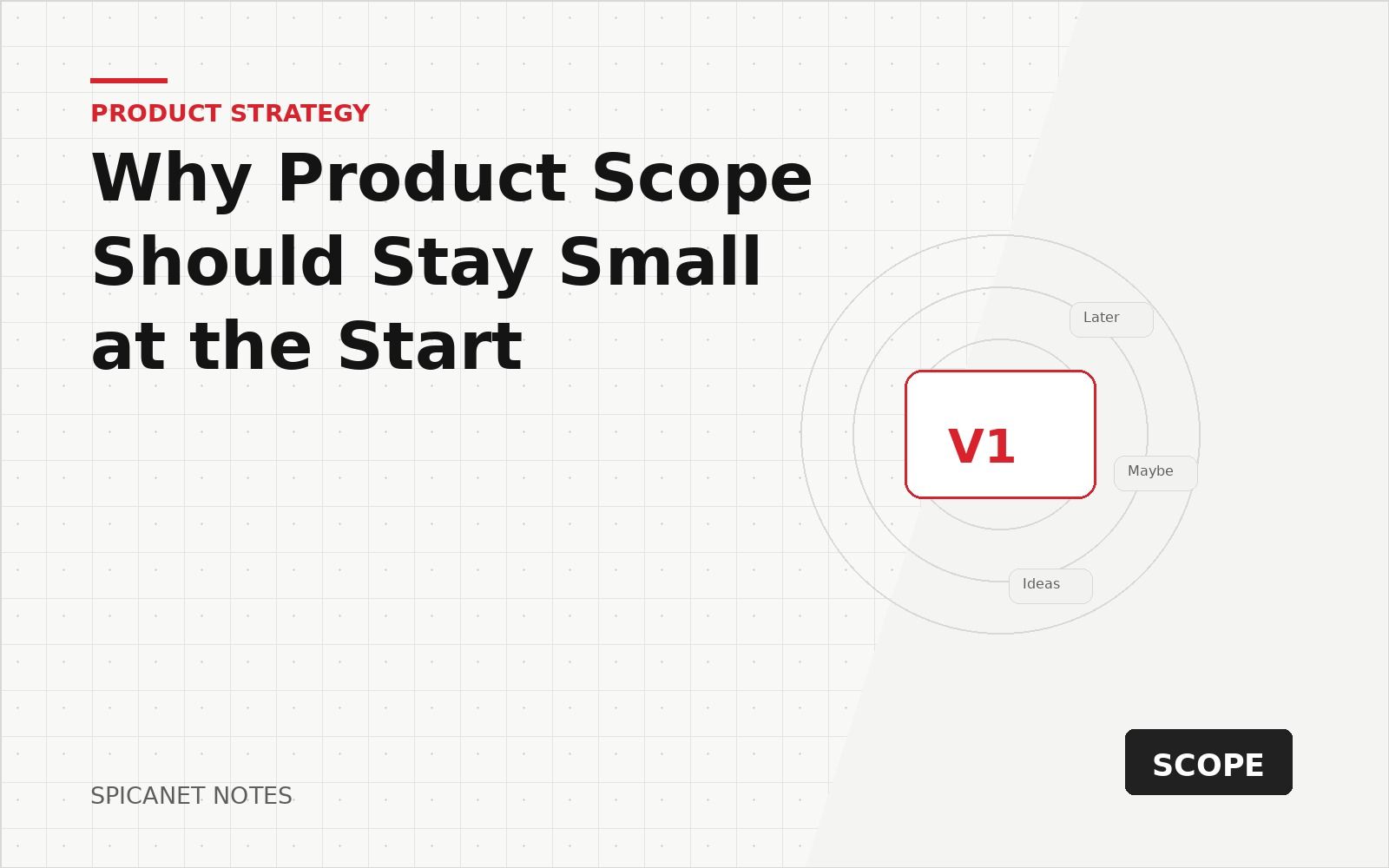
Good feature cutting is not random. The team should keep a visible later list so useful ideas are not lost. This reduces emotional resistance because the decision is postpone, not forget.
Each postponed feature should have a reason. Later decisions become easier when the team can see why something was cut and what evidence would bring it back.
- Cut because the first user can receive value without it.
- Cut because it needs data that does not exist yet.
- Cut because it adds risk to payment, security, or privacy.
- Cut because manual handling is acceptable for the first users.
- Cut because it cannot be tested meaningfully before launch.
Manual work can be a valid launch tool
Many founders try to automate too early. In the first version, some operations can be manual if the volume is low and users still receive the promised result.
Manual work can reveal what should be automated later. It also helps the team understand the problem before building a large system around it.
- Manual review before public content is published.
- Manual onboarding for the first customers.
- Manual data import for the first dataset.
- Manual support for edge cases.
- Manual reporting until report requirements are proven.
Explain small scope clearly to clients and stakeholders
Small scope can be misunderstood as a lack of ambition. The team should explain that the first release is intentionally focused to reduce waste and reach real feedback sooner.
A written scope document helps avoid disappointment. It should show what is included, what is excluded, why it is excluded, and what will be reviewed after launch.
- Included now: features required for the main user path.
- Handled manually: tasks that do not need automation yet.
- Planned later: useful ideas that need user evidence first.
- Not planned: ideas that do not match the product promise.
- Review date: when the team will decide the next release scope.
- Does this feature help the first user receive value?
- Can we launch without it?
- Will it make the first release harder to test?
- Does it answer a business question now?
- Can this be handled manually for the first users?
- Does this add risk to payments, privacy, permissions, or data?
- Will the team know whether this feature worked after launch?
- Is this feature needed by the first audience or only by a future audience?
Expand only after the first signal is clear
After launch, the team should not immediately add everything from the later list. The next release should be based on real usage, support messages, failed flows, and direct user conversations.
The best second release usually improves the main path before adding a new path. Faster onboarding, clearer forms, better empty states, and stronger admin tools may produce more value than a flashy feature.
- Fix blockers before adding new features.
- Improve the main path before adding a second path.
- Use real user language in copy and onboarding.
- Promote only after the product can handle the current user flow reliably.